Product Details
Ürün Kodu A0703
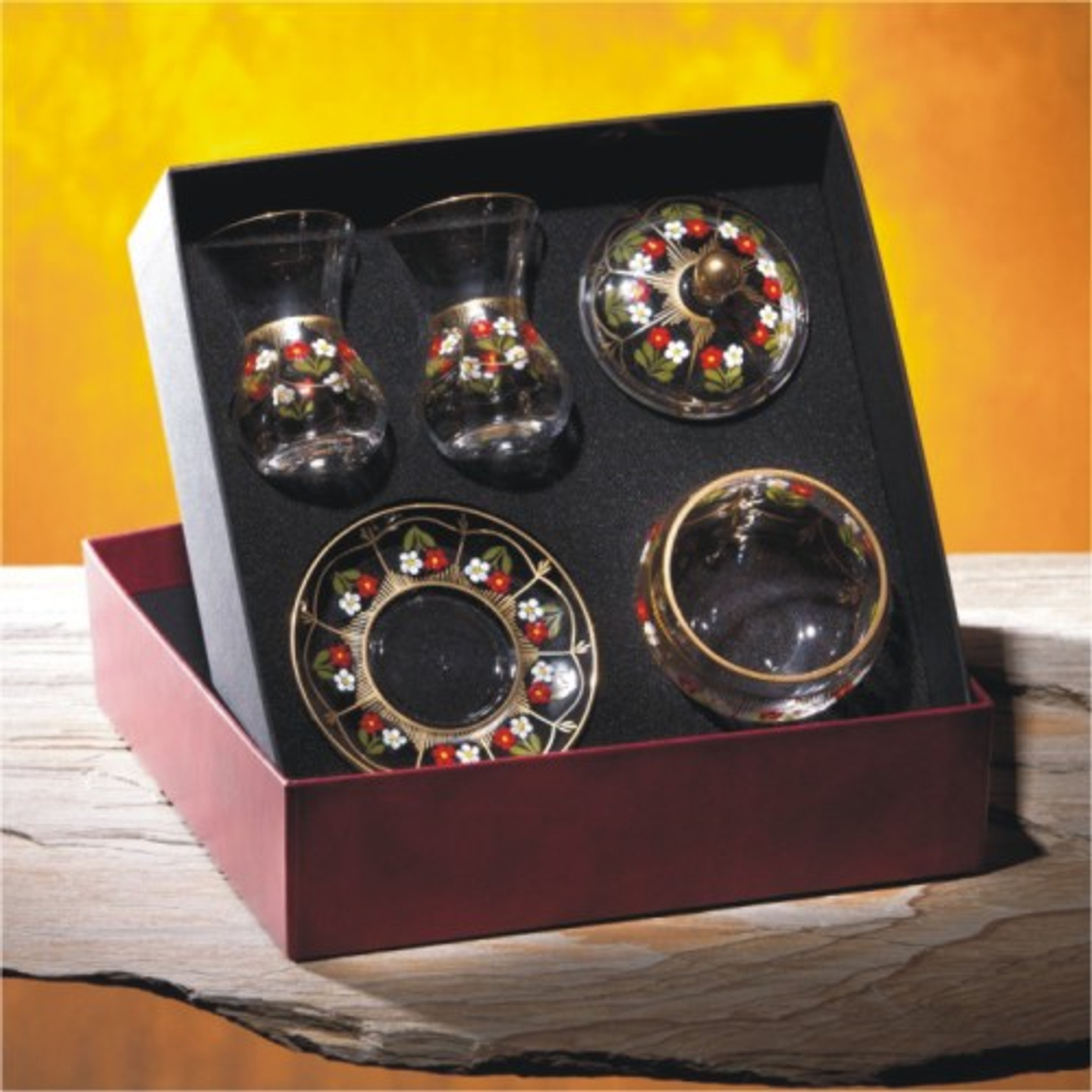
Ambalaj Karton Hediye Kutusu
Ambalaj Ölçüsü 27.5 x 28.5 x 9.5cm
Ürünler
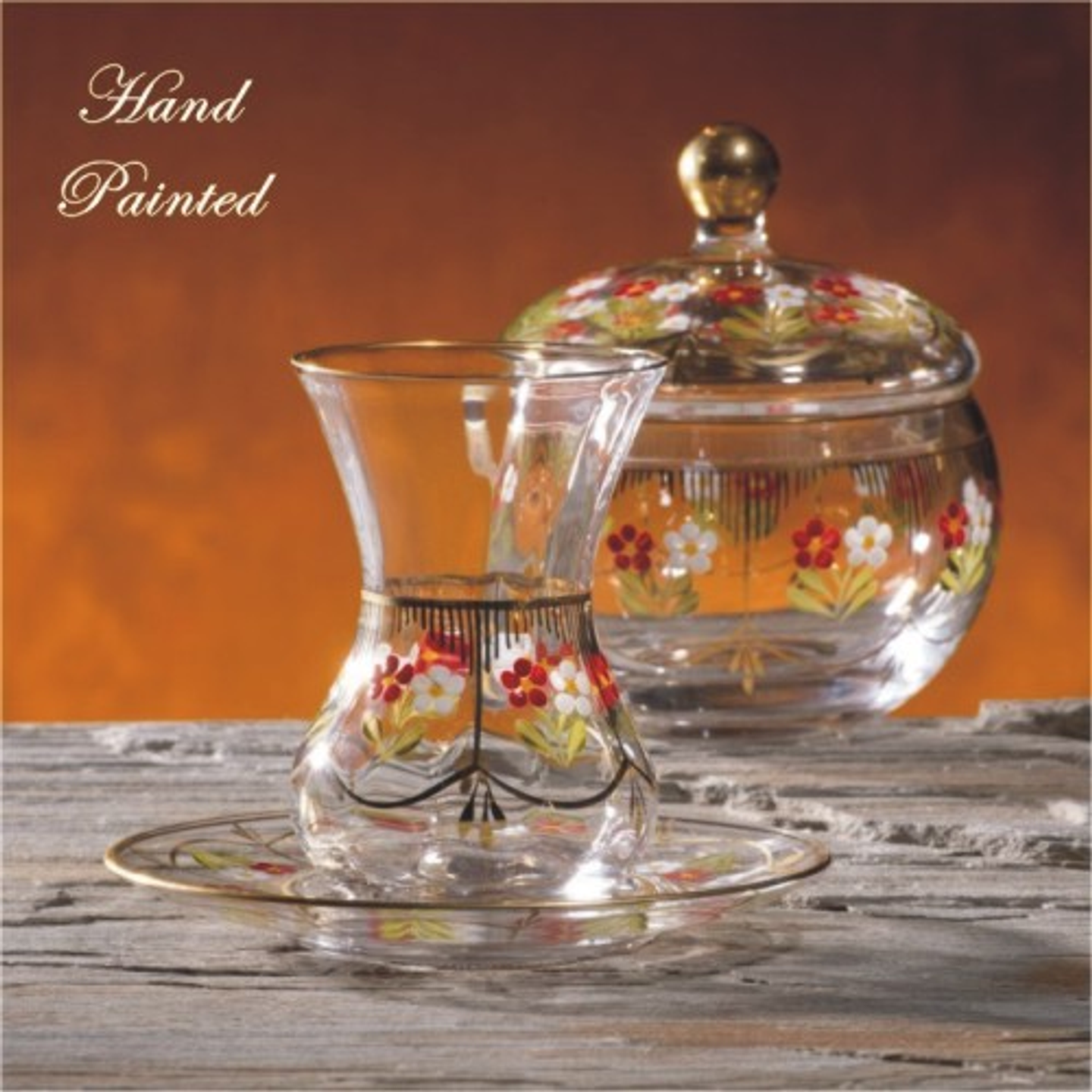
- Glass cup (2 pcs)
- Glass plate (2 pcs)
- Glass sugar bowl (1 pc)
Why is Akşam Sefası Tea Set the right gift choice for corporate companies?
Considering that a world without tea is unimaginable for Turks; there has been a need for many pieces of equipment related to brewing tea, serving tea, offering tea, and drinking tea. Besides their functionality, it is also of great importance that these pieces of equipment are aesthetically pleasing. Given that drinking tea is a matter of enjoyment, the presentation should be careful and provide visual pleasure to the tea drinker. For this reason, every home has carefully purchased tea cups, tea plates, tea spoons, and tea trays, in short, tea sets, for both daily use and serving guests. Here is the Akşam Sefası Tea Set, an elegant set that is visually appealing -entirely handcrafted- and produced by hand painting.
The main purpose of designing the Akşam Sefası Tea Set was to bring a different proposal to companies looking for corporate gifts. Companies in search of corporate gifts constantly expect us to offer different and innovative corporate gift alternatives. The Akşam Sefası Tea Set is a very attractive and delightful gift set with its product design. Especially since foreigners associate tea with Turks, they show great favor to specially designed tea sets. The tea cups and sugar bowls in the Akşam Sefa Tea Set are entirely hand-painted products.
Companies attach great importance to the gift box. The Akşam Sefası Tea Set has a pleasant presentation with its handmade cardboard gift box. Since we can print the gold foil company logo on the lid of the tea set's gift box, it perfectly fits the corporate gift purpose. Thus, companies can do their corporate promotion with this corporate gift. For companies looking for corporate gifts, event gifts, or corporate promotion, the Akşam Sefası Tea Set is a very elegant alternative.
The Historical Journey of Tea
Tea, contrary to popular belief, entered Turkey very late. Although Turkey is among the countries that consume the most tea in the world, Turks did not know tea until the 1900s. With the culture inherited from the Ottomans, Turks were complete 'coffee addicts'. But today, tea has become the most frequently consumed beverage after water in Turkey. If we were to take a brief historical journey about tea; it is derived from the Chinese word 'Cha'. All languages use words derived from this root for tea. Tea was first encountered in a document written in China 2700 years ago, in 2700 BC. However, records indicate that it was used only as medicine.
Tea became the national drink of the Chinese only 400 years after Christ. With the beginning of commercial relations in the Middle Ages, the value of tea was gradually understood and it spread all over the world. Around 350 AD, the Chinese went to Ceylon by ships and traded their goods with those brought by Arab and Persian ships. From the 8th century onwards, Arab and Persian ships went as far as China. From the 15th century onwards, tea arrived in Central Asia by land, and thus Tibetans began to use it generally.
Europe only received news about tea during the Crusades. Famous travelers Giovanni Battista Ramusio (1559), L. Almedia (1588), and Tareira (1610) first mentioned tea in the 16th century. However, they did not provide precise information about its preparation. In 1610, ships of the Dutch East India Company brought the first tea to Holland, and it soon became a popular beverage. The first tea arrived in Paris in 1635, and in London in 1650. It reached Russia by land in 1638. It entered Germany in 1647. The adoption of tea by the public stemmed from many doctors recommending it.
According to research, the Turks' acquaintance with tea dates back to Central Asia in the 12th century. It is written in the book Fevakihü'l-Cülesa by Abdül'l-Kayyum Nasıri, a Kazan Crimean Turk and language reformist, that the first Turk to drink tea was Hoca Ahmet Yesevi.
The first experiments on tea cultivation in Turkey were carried out in Bursa in 1888 during the time of Abdülhamit II, and successful results could not be obtained. In 1924, some experiments were carried out in Rize with seeds brought from the Caucasus, and good results were obtained because seeds suitable for the climate were used. With the law enacted in 1939, tea cultivation developed rapidly. Tea cultivation in our country first started around Rize and spread over time. Today, tea cultivation is carried out in the Black Sea coast region from Sürmene to Hopa, in areas up to 500 m above sea level from the coast.
Günümüzde çay kültürümüzle öyle özdeşlemiştir ki; it is indispensable for conversations, one-on-one chats, relieving fatigue, enjoying oneself, joining a conversation, and warming up the atmosphere. We wake up in the morning and drink tea, we drink tea at work, we drink it after lunch, we have afternoon tea, we have evening tea, our first task after iftar is to drink tea, we don't go to bed without drinking tea in the evening. In short, we drink tea all day long. When a beverage penetrates so deeply into our lives, many idioms related to tea have inevitably emerged in our language… Hare's blood tea, kıtlama tea, slurping tea, Pasha tea, offering tea… Many of us also add various things to tea, from cinnamon and cloves to ginger.